
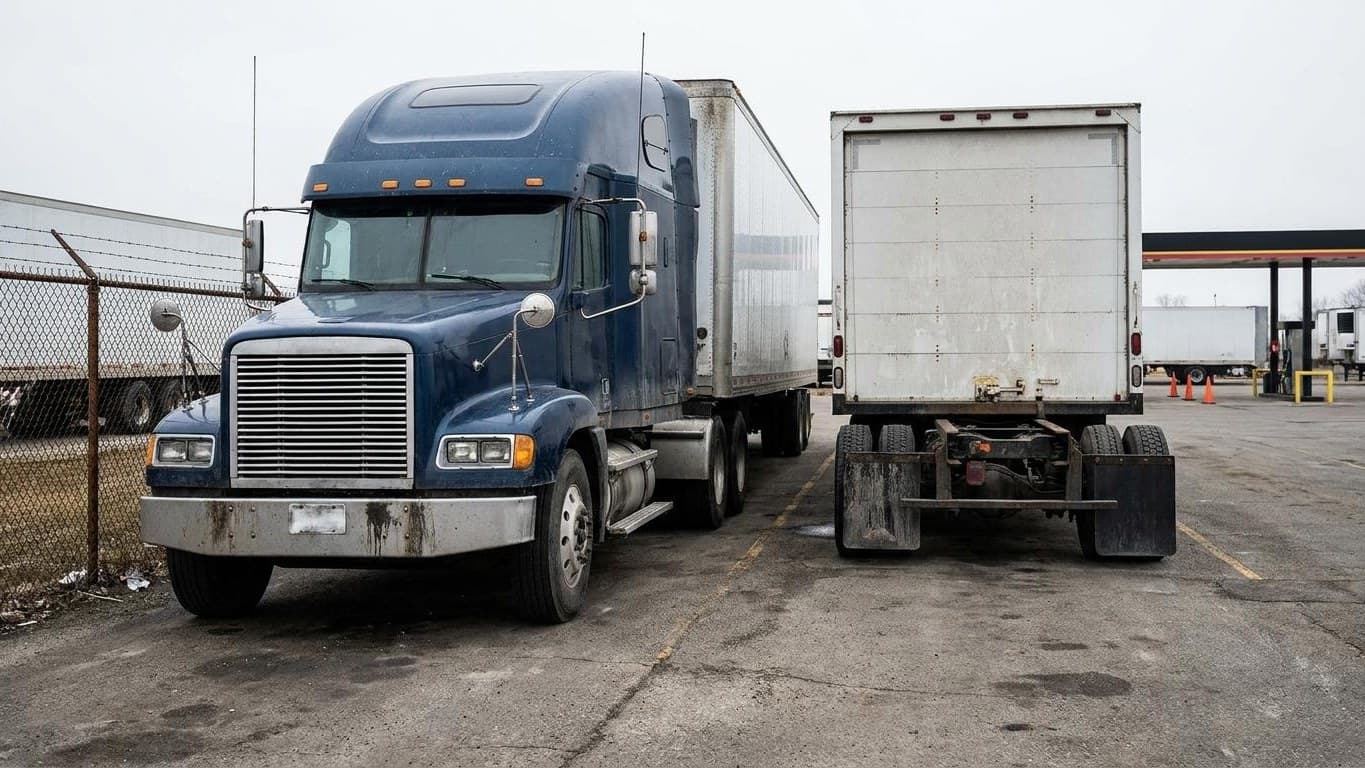
Key takeaways
- A Class A CDL is the license for the combination, rated 26,001 pounds or more for the units together, with the towed unit rated over 10,000 pounds (49 CFR 383.91(a)).
- Class B stays on one frame, at a rating of 26,001 pounds or more.
- Class C is defined by what it is not, with 16 or more passengers including the driver, or hazardous materials, as the trigger.
- 383.91(c) lets a Class A holder drive Class B and C vehicles, and a Class B holder drive Class C, only with the requisite endorsements. The reverse means retaking all the related tests.
- Any knowledge test is passed at 80% (49 CFR 383.135). Age floors live in other sections, 18 for a permit (383.25(a)(4)) and 21 for interstate work (391.11(b)(1)). The Bureau of Labor Statistics reports pay by occupation, not by class.
What are the types of CDL? Class A, B and C under 49 CFR 383.91
Three classes exist, and the split runs on weight ratings and on what the vehicle carries. The rule calls them Group A, Group B and Group C, while the card in your wallet carries the letter alone. For Group A, 49 CFR 383.91(a) sets out "Any combination of vehicles with a gross combination weight rating (GCWR) of 11,794 kilograms or more (26,001 pounds or more) provided the GVWR of the vehicle(s) being towed is in excess of 4,536 kilograms (10,000 pounds)."
Group B comes down to one unit, and the rule writes it as "Any single vehicle with a GVWR of 11,794 kilograms or more (26,001 pounds or more), or any such vehicle towing a vehicle not in excess of 4,536 kilograms (10,000 pounds) GVWR."
Anything outside those two weights can still need a CDL. The rule puts that as "Any single vehicle, or combination of vehicles, that meets neither the definition of Group A nor that of Group B as contained in this section, but that either is designed to transport 16 or more passengers including the driver, or is used in the transportation of hazardous materials."
| Class | What the rule covers | Knowledge tests, in most states |
|---|---|---|
| A | A combination rated 26,001 pounds or more, towing a unit over 10,000 pounds GVWR | General Knowledge, Combination Vehicles, Air Brakes unless you accept the air brake restriction |
| B | A single vehicle rated 26,001 pounds or more, towing nothing over 10,000 pounds | General Knowledge, Air Brakes unless you accept the air brake restriction |
| C | Neither A nor B, but built for 16 or more passengers including the driver, or hauling hazardous materials | General Knowledge, plus the endorsement test the work needs |
Can a Class A or Class B holder drive a lower class?
Downhill only. 383.91(c) starts from the strict position, that a driver wanting a group the license was not issued for has to retake and pass all the related tests. Two exceptions follow it. A Group A holder may operate Group B and Group C vehicles, a Group B holder may operate Group C vehicles, and in both cases only with the requisite endorsements.
Everything hangs on the last five words.
A class buys you weight. Nothing else. Passengers come with the P endorsement and hazardous loads with H, so a Class A license carrying no P will not put a driver in the seat of a bus that sits a group below it.
Going up has no shortcut. A Class B driver who decides on Class A later goes back through every test Group A requires.
What can you drive with a Class A CDL?
Combinations are the point of a Class A, plus whatever lighter work the endorsements reach. The arithmetic is all there is to it, 26,001 pounds or more rated for the combination and the towed unit above 10,000 pounds. On its commercial driver license page New York's DMV gets the class into two words, "tractor-trailer".
Through 383.91(c) that same license reaches the straight truck and the Class C vehicle, only with the requisite endorsements.
Specialty work comes a letter at a time. T for doubles and triples. N for a tanker. H for hazmat, and X where H and N go together.
Class A CDL requirements before the permit
18 years of age is the federal floor for a Group A commercial learner's permit, under 49 CFR 383.25(a)(4). Knowledge tests come before the permit too, and on one of them 49 CFR 383.135(a)(3) leaves no argument, since failing the combination portion means a Group A CLP cannot be issued. Entry-level driver training lands later, before the skills test.
What can I drive with a Class B CDL?
One heavy vehicle on one frame, with a light trailer behind it if the job calls for one. The threshold is a GVWR of 26,001 pounds or more, and nothing above 10,000 pounds GVWR on the hitch.
What the body on the frame happens to be does not enter into it.
A dump truck or a concrete mixer rated at or above 26,001 pounds is Class B work on weight alone. Washington's DOL describes its Class B as "Any single vehicle with a GVWR of 26,001 pounds or more", and the examples it gives include school buses and public transportation buses.
Buses make this plain. One rated 26,001 pounds or more is Class B on the rating, while a lighter bus built for 16 passengers, driver included, is Group C instead.
Class B CDL requirements
General Knowledge, at the same 80% and the same 18 for a permit. Combination Vehicles does not come into it. Fail the air brake portion, or test in a vehicle without air brakes, and the L restriction follows. A first Class B needs entry-level driver training as well, before the skills test.
What is a Class C CDL used for?
A Class C CDL covers what the two weights leave out. The vehicle is neither Group A nor Group B, yet it is built for 16 or more passengers including the driver, or it hauls hazardous materials. Two unlike vehicles end up in the same class that way: a shuttle van with 16 seats and a light truck with a placarded load aboard. Hazardous materials has a narrow meaning here. Under 49 CFR 383.5 it is a material that "is required to be placarded under subpart F of 49 CFR part 172", or any quantity of a listed select agent or toxin.
Endorsements say more here than the letter does. P for passengers, S for a school bus, H for hazmat, N for a tank. New York's DMV even puts a stretch limo under its Class C.
Letters travel badly between documents, too. California's DMV issues a noncommercial Class B for a housecar or motorhome, and the everyday Basic driver license in California is a Class C, "A standard vehicle or truck for personal use on California roadways". So a Class C license there is not a Class C CDL.
Which knowledge tests does each class need?
Everybody takes General Knowledge. One or two more tests follow from the class, and 49 CFR 383.135 fixes the bar for all of them.
"To achieve a passing score on each of the knowledge tests, a driver applicant must correctly answer at least 80 percent of the questions."
The percentage is federal. How many questions sit behind it is a state matter, and in most states, Washington DOL for example, the General Knowledge test runs 50 questions with 40 to pass, Combination Vehicles 20 with 16, and Air Brakes 25 with 20.
Two more lines in 383.135 are worth reading before you book. Fail the air brake portion and "an air brake restriction must be indicated on the CLP or CDL". Fail the combination portion and Group A goes away, since a driver applicant who fails it "must not be issued a Group A CLP or CDL."
Practice questions for all eight knowledge tests sit in the CDL Practice Test app, sorted by test and by topic, every answer explained, with a pre-trip study quiz and a plan that runs up to your test date in English or Spanish.
What restrictions come from the vehicle you test in?
The vehicle you take to the skills test leaves its mark on the license afterward. Take an automatic, and 49 CFR 383.95 gives the state no discretion: "the State must indicate on the CDL, if issued, that the person is restricted from operating a CMV equipped with a manual transmission." Six codes come out of the tests this way, written out in 49 CFR 383.153.
| Code | What it blocks | Where it comes from |
|---|---|---|
| L | No air brake equipped CMV | Failing the air brake knowledge test, or testing in a vehicle without air brakes |
| Z | No full air brake equipped CMV | Skills test in a vehicle with air over hydraulic brakes |
| E | No manual transmission equipped CMV | Skills test in a vehicle with an automatic transmission |
| O | No tractor-trailer CMV | Group A skills test with a pintle hook or other non-fifth wheel connection |
| M | No Class A passenger vehicle | Passenger endorsement skills test in a Group B passenger vehicle |
| N | No Class A and B passenger vehicle | Passenger endorsement skills test in a Group C passenger vehicle |
Section 383.153 uses N twice over. As an endorsement the letter means a tank vehicle. As a restriction it bars Class A and B passenger vehicles. Which of the two you are looking at depends on where it sits on the card, worth knowing before you read your own.
Which endorsements go with each class, and which ones a CLP can carry?
Endorsements sit on top of the class, and all three classes can carry them. 49 CFR 383.93(b) lists what calls for one: "An operator must obtain State-issued endorsements to his/her CDL to operate commercial motor vehicles which are: (1) Double/triple trailers; (2) Passenger vehicles; (3) Tank vehicles; (4) Used to transport hazardous materials as defined in § 383.5; or (5) School buses." In 383.153 those come out as T, P, N, H, X and S.
A permit is narrower than a license here. The same section is short about it: "The only endorsements allowed on a CLP are the following: (i) Passenger (P); (ii) School bus (S); and (iii) Tank vehicle (N)." Hazmat, doubles and triples wait for the license itself. Practice for each of them sits on the practice test hub, one test at a time.
How old do you have to be for each class?
Two numbers answer two different questions. On a permit, 383.25(a)(4) runs to one line: "The CLP holder must be 18 years of age or older." For interstate driving, 49 CFR 391.11(b)(1) asks that a driver "Is at least 21 years old". Neither number moves with the class.
Neither rule covers the ground between 18 and 21, so look at your own agency's page rather than a national summary. California's DMV sets its line out on its commercial driver information page. A driver there "May drive for a commercial company if you are 18 to 20 years old, possess a CDL, and your load does not originate from outside of CA", and "Must be at least 21 years old to drive a commercial motor vehicle that transports interstate commerce or hazardous materials or wastes within CA or across state lines." California's wording, for California.
Does entry-level driver training (ELDT) apply to your class?
Which credential you are after decides this, not how long you have held a car license. 49 CFR 380.605 defines an entry-level driver as someone who must complete the CDL skills test requirements "prior to receiving a CDL for the first time, upgrading to a Class A or Class B CDL, or obtaining a hazardous materials, passenger, or school bus endorsement for the first time." Any provider has to appear on FMCSA's Training Provider Registry. The training belongs before the skills test and not before the permit knowledge tests, with a first hazmat endorsement as the one exception, where it comes before the H knowledge test.
A date in the rule closes it off. 49 CFR 380.603(b) grandfathers the drivers who came earlier: "Drivers issued a Class A CDL, Class B CDL, or a passenger (P), school bus (S), or hazardous materials (H) endorsement before February 7, 2022, are not required to comply with this subpart pertaining to that CDL or endorsement." Hold a Class B issued in 2019, upgrade to Class A now, and the upgrade brings you back inside the rule.
Which CDL class should you get?
Start from the vehicle. Nothing in the federal rules ranks the classes, and 383.91(c) has settled how far each license reaches, with Group A covering Group B and C vehicles with the requisite endorsements and Group B stopping at Group C.
Four questions get you to the letter:
- one unit, or a tractor and a trailer;
- the rating of whatever sits on the hitch, over or under 10,000 pounds;
- 16 passengers, the driver counted in;
- hazardous materials.
A trailer rated over 10,000 pounds, in a combination rated 26,001 pounds or more, means Class A, with the Combination Vehicles test alongside it. A mixer, a refuse truck or a transit bus rated 26,001 pounds or more means Class B. Sixteen seats or a hazardous load in a lighter vehicle is Class C, plus the endorsement the work calls for.
What drivers most want compared is often not published at all. Pay by class is the clearest case. The Bureau of Labor Statistics reports that "The median annual wage for heavy and tractor-trailer truck drivers was $58,640 in May 2025", an occupation figure and not a figure for a letter on a card. Fees sit with the states, so New York's DMV charging $10 for the permit knowledge tests and $40 for the road test tells you about New York alone. No federal rule sets a time limit for a knowledge test either. The clock on a practice test, this site's included, is practice pacing and not a rule.